

Shock absorption is a crucial factor in the performance and safety of tank heads, especially in high - pressure and dynamic environments. As a leading supplier of hot formed tank heads, I have in - depth knowledge of the shock - absorption properties of these products. In this blog, I will explore what shock - absorption properties of hot formed tank heads are and why they matter.
Understanding Shock Absorption in Tank Heads
Shock absorption refers to the ability of a material or structure to dissipate and reduce the impact energy caused by sudden forces or vibrations. In the context of tank heads, these forces can come from various sources, such as pressure surges, mechanical impacts during transportation or installation, and seismic activities.
Hot formed tank heads are made through a process where the metal is heated to a specific temperature and then shaped into the desired form. This process not only gives the tank heads their precise shape but also affects their mechanical properties, including shock - absorption capabilities.
Factors Affecting Shock - Absorption Properties
Material Selection
The choice of material is fundamental to the shock - absorption properties of hot formed tank heads. Common materials used in manufacturing tank heads include carbon steel, stainless steel, and alloy steel. Each material has different mechanical properties that influence how it responds to shocks.
Carbon steel is widely used due to its relatively low cost and good strength. It has a certain ability to absorb energy through plastic deformation. When a shock occurs, the carbon steel tank head can deform slightly, which helps to dissipate the impact energy. However, excessive deformation may lead to permanent damage or failure of the tank head.
Stainless steel, on the other hand, offers better corrosion resistance and higher strength - to - weight ratio. It has a more uniform crystal structure, which allows it to distribute stress more evenly during a shock. This results in a more stable shock - absorption performance compared to carbon steel.
Alloy steel contains additional alloying elements such as chromium, nickel, and molybdenum. These elements enhance the strength, toughness, and shock - absorption capacity of the tank head. Alloy steel tank heads are often used in high - stress applications where superior shock - absorption properties are required.
Heat Treatment
The heat treatment process during hot forming also plays a significant role in determining the shock - absorption properties of tank heads. Heat treatment can modify the microstructure of the metal, which in turn affects its mechanical behavior.
For example, quenching and tempering are common heat treatment methods. Quenching involves rapid cooling of the heated metal, which forms a hard and brittle martensitic structure. Tempering is then carried out to reduce the brittleness and increase the toughness of the material. A well - tempered tank head can absorb more energy during a shock without fracturing.
Normalizing is another heat treatment process that can improve the shock - absorption properties. It involves heating the metal to a specific temperature and then cooling it in air. Normalizing refines the grain structure of the metal, making it more resistant to shock and fatigue.

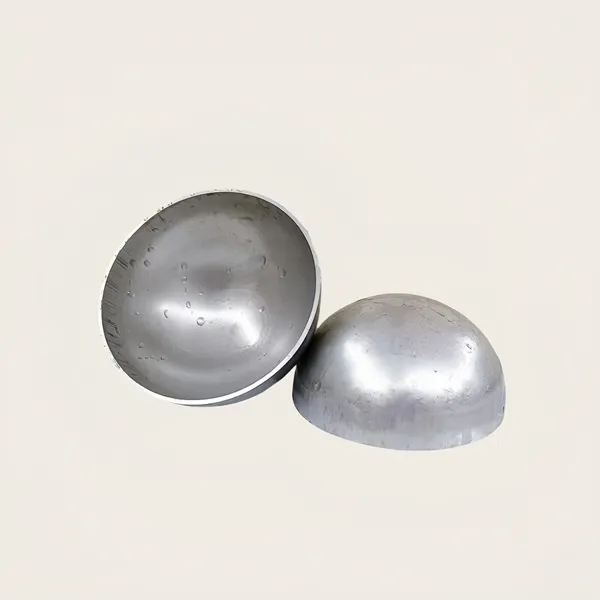
Geometric Design
The geometric design of the tank head also impacts its shock - absorption capabilities. Different types of tank heads, such as Pressure Vessel Hemispherical Dished End, Torispherical Dished Head, and Ms Dish End, have distinct shapes that respond differently to shocks.
Hemispherical tank heads have a uniform stress distribution under internal pressure. When a shock occurs, the hemispherical shape allows the stress to be evenly spread across the surface, reducing the likelihood of stress concentration. This results in a relatively good shock - absorption performance.
Torispherical tank heads have a combination of a spherical section and a toroidal section. The toroidal section provides some flexibility, which can help to absorb shocks by deforming slightly. However, the transition area between the spherical and toroidal sections may be a potential weak point where stress concentration can occur.
Ms Dish End, depending on its specific design and manufacturing process, also has its own shock - absorption characteristics. The shape and thickness distribution of the dish end can be optimized to enhance its ability to withstand shocks.
Importance of Shock - Absorption Properties
The shock - absorption properties of hot formed tank heads are of great importance for several reasons.
Safety
In industries such as oil and gas, chemical processing, and power generation, tank heads are often used in high - pressure systems. A sudden shock, such as a pressure surge or an earthquake, can cause significant damage to the tank if the tank head does not have adequate shock - absorption capabilities. This can lead to leaks, explosions, and other safety hazards, endangering the lives of workers and the surrounding environment.
By ensuring that the tank heads have good shock - absorption properties, the risk of catastrophic failures can be significantly reduced. This helps to maintain the safety of the entire system and protect the people and assets involved.
Equipment Longevity
Shocks can cause fatigue and wear on tank heads over time. If the tank head cannot effectively absorb and dissipate the impact energy, the repeated stress can lead to cracks, fractures, and other forms of damage. This shortens the service life of the tank and increases the maintenance and replacement costs.
Tank heads with excellent shock - absorption properties can withstand the repeated shocks without significant damage. This extends the lifespan of the tank, reduces the frequency of maintenance, and ultimately saves costs for the users.
Process Stability
In industrial processes, the stability of the pressure vessels is crucial for the smooth operation of the entire production line. A tank head that can absorb shocks effectively helps to maintain a stable internal pressure, preventing fluctuations that could disrupt the process. This ensures the quality and consistency of the products being produced.
Our Offerings as a Supplier
As a supplier of hot formed tank heads, we are committed to providing products with superior shock - absorption properties. We use high - quality materials and advanced manufacturing processes to ensure the best performance of our tank heads.
Our team of experienced engineers carefully selects the appropriate materials based on the specific requirements of the application. We also optimize the heat treatment process to enhance the mechanical properties of the tank heads, including their shock - absorption capabilities.
In addition, we offer a wide range of tank head designs, such as hemispherical, torispherical, and Ms Dish End, to meet the diverse needs of our customers. Our in - house testing facilities allow us to conduct rigorous quality control to ensure that each tank head meets or exceeds the relevant industry standards.
Contact Us for Procurement
If you are in need of hot formed tank heads with excellent shock - absorption properties, we invite you to contact us for procurement discussions. Our sales team is ready to provide you with detailed product information, customized solutions, and competitive pricing. We look forward to working with you to meet your tank head requirements.
References
- "Pressure Vessel Design Handbook" by Dennis R. Moss
- "Materials Science and Engineering: An Introduction" by William D. Callister Jr. and David G. Rethwisch
- Industry standards such as ASME Boiler and Pressure Vessel Code for relevant information on tank head design and performance.