

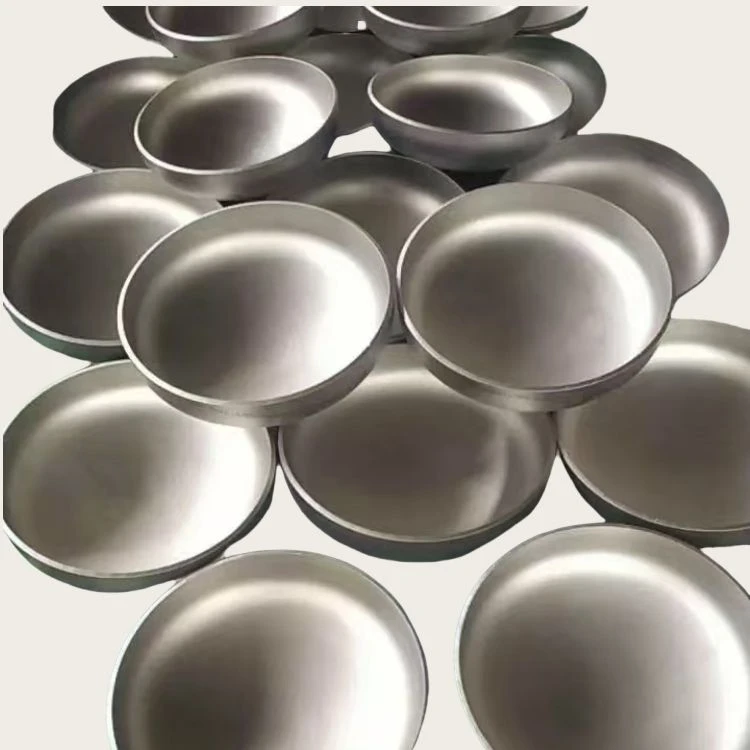
Elasticity is a fundamental mechanical property that describes a material's ability to deform under stress and return to its original shape once the stress is removed. In the context of mild steel end caps, understanding elasticity is crucial for assessing their performance in various applications. As a supplier of mild steel end caps, I have witnessed firsthand the importance of this property in ensuring the reliability and durability of our products.

What is Elasticity?
Elasticity is defined by Hooke's Law, which states that the stress applied to a material is proportional to the strain it undergoes within the elastic limit. Stress is the force applied per unit area, while strain is the resulting deformation relative to the original size. The ratio of stress to strain is known as the elastic modulus, or Young's modulus, which is a measure of a material's stiffness.
For mild steel, the elastic modulus typically ranges from 190 to 210 GPa (gigapascals). This relatively high value indicates that mild steel is a stiff material that can withstand significant stress without permanent deformation. However, it's important to note that the elastic limit of mild steel is not infinite. Once the stress exceeds this limit, the material will enter the plastic deformation region, where it will not fully recover its original shape.
Importance of Elasticity in Mild Steel End Caps
Mild steel end caps are used in a wide range of applications, including piping systems, pressure vessels, and structural components. In these applications, the end caps are often subjected to various types of stress, such as internal pressure, external loads, and thermal expansion. The elasticity of mild steel plays a crucial role in ensuring that the end caps can withstand these stresses without failing.
One of the primary benefits of using mild steel end caps with good elasticity is their ability to absorb and distribute stress evenly. When a stress is applied to an end cap, the elastic deformation allows the material to stretch and compress, effectively spreading the stress over a larger area. This helps to prevent localized stress concentrations, which can lead to premature failure.
In addition, the elasticity of mild steel end caps allows them to accommodate minor variations in the dimensions of the pipes or vessels they are attached to. During installation, it's common for there to be slight differences in the diameter or length of the components. The elastic deformation of the end caps allows them to conform to these variations, ensuring a tight and secure fit.
Factors Affecting the Elasticity of Mild Steel End Caps
Several factors can affect the elasticity of mild steel end caps. One of the most significant factors is the composition of the steel. Mild steel typically contains between 0.05% and 0.25% carbon, along with small amounts of other elements such as manganese, silicon, and sulfur. The exact composition can vary depending on the specific grade of mild steel, which can have a significant impact on its mechanical properties, including elasticity.
Another factor that can affect the elasticity of mild steel end caps is the manufacturing process. The way the end caps are formed, such as by forging, casting, or machining, can influence their internal structure and, consequently, their elastic properties. For example, forging can improve the grain structure of the steel, resulting in a more uniform and consistent elastic modulus.
The heat treatment of mild steel end caps can also have a significant impact on their elasticity. Heat treatment processes such as annealing, quenching, and tempering can alter the microstructure of the steel, affecting its strength, hardness, and elasticity. For example, annealing can reduce the internal stresses in the steel, improving its ductility and elasticity.
Testing the Elasticity of Mild Steel End Caps
To ensure the quality and performance of mild steel end caps, it's important to test their elasticity. There are several methods available for testing the elastic properties of materials, including tensile testing, compression testing, and flexural testing.
Tensile testing is the most common method for measuring the elasticity of mild steel end caps. In this test, a sample of the end cap is subjected to a gradually increasing tensile force until it reaches its breaking point. The stress and strain are measured throughout the test, and the elastic modulus is calculated from the slope of the stress-strain curve within the elastic region.
Compression testing is another method that can be used to measure the elasticity of mild steel end caps. In this test, a sample of the end cap is subjected to a compressive force, and the stress and strain are measured. Compression testing is particularly useful for evaluating the performance of end caps in applications where they are subjected to internal pressure.
Flexural testing can also be used to measure the elasticity of mild steel end caps. In this test, a sample of the end cap is supported at two points and a load is applied at the center. The deflection of the sample is measured, and the elastic modulus is calculated from the relationship between the load and the deflection.
Applications of Mild Steel End Caps
Mild steel end caps are used in a wide range of applications across various industries. Some of the most common applications include:
- Piping Systems: Mild steel end caps are used to seal the ends of pipes in plumbing, HVAC, and industrial piping systems. They help to prevent leakage and protect the pipes from corrosion and damage.
- Pressure Vessels: In pressure vessel applications, mild steel end caps are used to close the ends of the vessels and withstand the internal pressure. They are designed to meet strict safety standards and ensure the integrity of the vessel.
- Structural Components: Mild steel end caps are also used in structural applications, such as in the construction of bridges, buildings, and machinery. They provide support and stability to the structures and help to distribute the loads evenly.
- Automotive Industry: In the automotive industry, mild steel end caps are used in various components, such as exhaust systems, fuel tanks, and suspension parts. They offer a combination of strength, durability, and cost-effectiveness.
Conclusion
In conclusion, the elasticity of mild steel end caps is a critical property that determines their performance and reliability in various applications. As a supplier of mild steel end caps, I understand the importance of ensuring that our products have the right elastic properties to meet the needs of our customers. By carefully selecting the appropriate grade of mild steel, using the right manufacturing processes, and conducting thorough testing, we can provide high-quality end caps that offer excellent elasticity and performance.
If you are in the market for mild steel end caps, I encourage you to contact us to discuss your specific requirements. We offer a wide range of Carbon Steel Buttweld Caps, Carbon Steel Pipe End Caps, and Cap A234 in various sizes and specifications to suit your needs. Our team of experts is always available to provide you with technical support and guidance to ensure that you choose the right product for your application.
References
- Callister, W. D., & Rethwisch, D. G. (2017). Materials Science and Engineering: An Introduction. Wiley.
- ASM International. (2004). ASM Handbook, Volume 1: Properties and Selection: Irons, Steels, and High-Performance Alloys. ASM International.
- Shigley, J. E., Mischke, C. R., & Budynas, R. G. (2004). Mechanical Engineering Design. McGraw-Hill.