

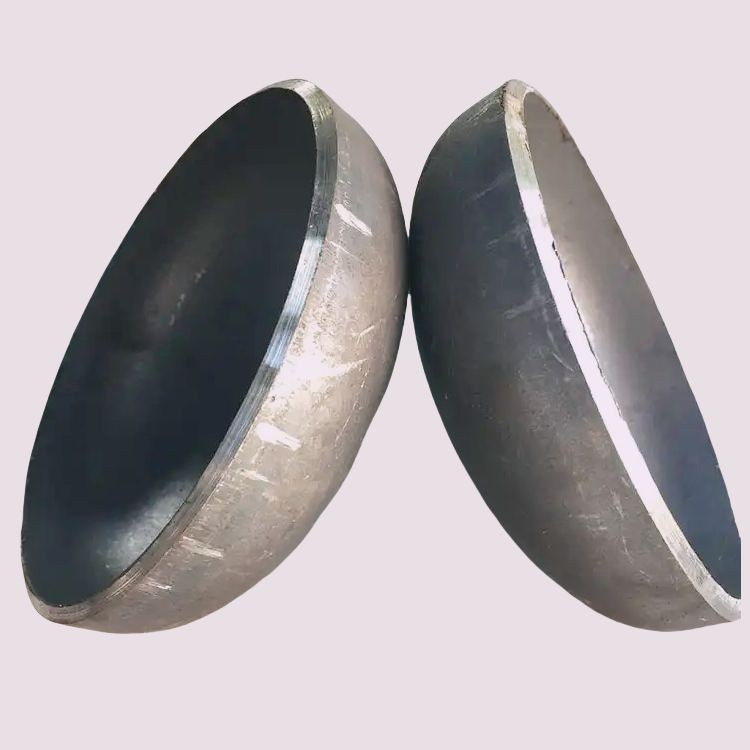
Dingjin's End Cap
Tube caps made by Dingjin are typically used at the ends of pipes, usually referring to outer diameter sizes such as 219, 273, and 325. They are also known as end caps, pipe covers, or blind flanges, and are installed on the pipe ends to block them. They are used to seal pipelines and serve the same function as pipe plugs; however, tube caps can be directly welded onto the pipes without requiring additional fittings.
Generally, they are used at the end of pipes for sampling purposes. The tube cap needs to be welded on after sampling is completed. Additionally, removing the tube cap allows for temporary continuous material collection or withdrawal by connecting another pipe in special situations.
Tube caps are commonly used under low-pressure conditions for easy disassembly and maintenance, but they are not permitted for use under medium and high pressure.

Parameter
|
Type |
Cap |
|
Manufacture Standard |
ASME B16.9 |
|
DN |
150 |
|
Limited Wall Thickness |
2.11mm~22.23mm |
|
Cutting Method |
Gas Cutting |
|
Forming Method |
Cold Forming |
|
Heat Treatment |
Not Required |
|
Material Designation |
Q235B |
|
Material Standard |
ASME |
|
Surface Treatment |
Sand Blasting |
|
NDT Method & Acceptance Cretiria |
Not Required |
Advantage
A low-carbon steel end cap, also known as a soft steel end cap, contains carbon ranging from 0.10% to 0.30%. It can be easily processed into various shapes.
Carbon steel with a carbon content below 0.25% has low strength and hardness, making it relatively soft and therefore referred to as soft steel. This category includes most common carbon structural steels and some high-quality carbon structural steels, which are typically used in engineering structures without heat treatment. Some are subjected to carburizing and other heat treatments for applications requiring wear resistance in mechanical parts.
The annealed structure of low-carbon steel consists of ferrite and a small amount of pearlite, resulting in low strength and hardness but good plasticity and toughness. Consequently, it has excellent cold formability and can be shaped through methods such as curling, bending, and stamping. This type of steel also demonstrates good weldability. Low-carbon steels with very low carbon content have poor machinability; however, quenching treatment can improve their machinability.

Welding Precaution for End Caps
Below are the experience shared by Dingjin as regards to welding end caps for your reference.
Due to excessive welding current, overheating of the workpiece by the welder, an excessively large assembly gap, or an overly slow welding speed, the arc may linger at a certain point along the seam for too long. In addition, insufficient backing support can cause molten metal to flow out from the backside of the joint during welding, forming a burn-through defect.
Burn-through is common in manual arc welding or submerged arc welding, often occurring in the first weld pass or in butt joints of thin plates. It is a welding defect that is not permitted.
Burn-through not only affects the appearance of the weld seam, reduces its cross-sectional area, and compromises its density, but also is often accompanied by defects such as slag inclusion, weld protrusion, and porosity near the burned-through area.


