

The optical properties of domed tank ends play a crucial role in various industrial applications. As a leading supplier of domed tank ends, I have witnessed firsthand how these properties can impact the performance and functionality of the tanks. In this blog, I will delve into the key optical properties of domed tank ends, their significance, and how they relate to our high - quality products.
1. Reflection
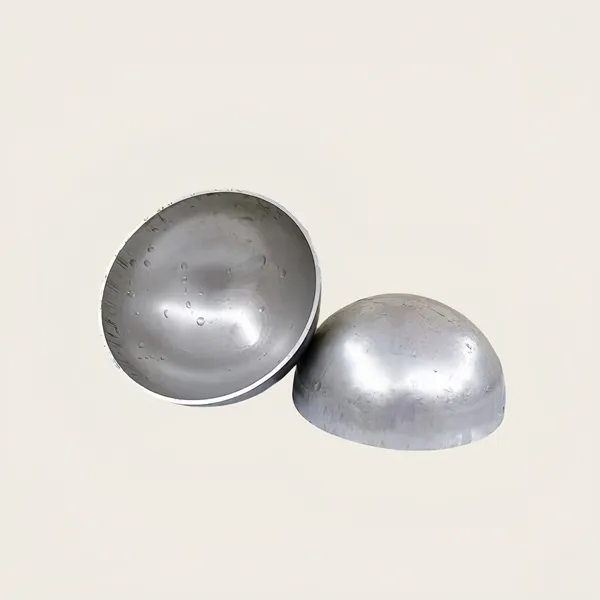
One of the primary optical properties of domed tank ends is reflection. The surface finish of the domed tank ends determines the amount and nature of light reflection. A smooth and polished surface will result in specular reflection, where light rays are reflected in a single direction. This type of reflection can be beneficial in applications where visibility and the ability to detect the tank's position are important. For example, in large industrial yards or storage facilities, a tank with a highly reflective domed end can be easily spotted by operators, enhancing safety and operational efficiency.
On the other hand, a rough or textured surface will cause diffuse reflection. In diffuse reflection, light rays are scattered in multiple directions. This can be advantageous in situations where glare needs to be minimized. For instance, in outdoor tanks exposed to direct sunlight, a domed end with a diffuse - reflecting surface will not cause blinding glare, which could potentially affect the vision of nearby workers or interfere with the operation of optical sensors.
Our company offers domed tank ends with different surface finishes to meet various requirements. Whether you need high - specular reflection for easy identification or diffuse reflection to reduce glare, we can provide a solution. You can explore our Ms Dish End products, which are available in a range of surface treatments to optimize reflection properties.
2. Transparency and Opacity
In some cases, the transparency or opacity of domed tank ends is a critical optical property. Transparent domed tank ends are used when it is necessary to visually inspect the contents of the tank without opening it. This is common in laboratories, pharmaceutical industries, and food processing plants, where real - time monitoring of the tank's contents is essential.
We can produce domed tank ends made from transparent materials such as high - quality plastics or glass. These materials offer excellent clarity, allowing for a clear view of the internal environment of the tank. However, transparency also has its limitations. Transparent materials may be more susceptible to scratches and UV damage, which can affect their optical clarity over time.
On the contrary, opaque domed tank ends are used when the contents of the tank need to be protected from light. Some chemicals, biological samples, or food products are sensitive to light and can degrade when exposed. Opaque domed tank ends made from materials like stainless steel or coated metals provide an effective barrier against light penetration. Our Flanged and Dished Tank Heads are available in both transparent and opaque options, ensuring that we can cater to different light - protection needs.
3. Refraction
Refraction is another optical property that can have an impact on the performance of domed tank ends. Refraction occurs when light passes from one medium to another with a different refractive index. In the context of domed tank ends, this can happen when light passes through the tank wall and into the liquid inside the tank, or vice versa.
The refractive index of the material used for the domed tank end affects the degree of refraction. A higher refractive index will cause light to bend more as it passes through the material. This property can be utilized in optical sensors installed on the tank. For example, if a sensor is used to measure the level of liquid in the tank based on the refraction of light, the refractive index of the domed tank end material needs to be carefully considered to ensure accurate measurements.
Our Pressure Vessel Hemispherical Dished End products are engineered with precise control over the refractive index of the materials. This ensures that they are compatible with a wide range of optical sensing systems, providing reliable and accurate data for tank monitoring.
4. Absorption
Light absorption is an important optical property, especially when dealing with tanks that store light - sensitive substances. The material of the domed tank end can absorb a certain amount of light, preventing it from reaching the contents of the tank. Different materials have different absorption spectra, which means they absorb light of different wavelengths.

For example, some polymers used in domed tank ends can absorb UV light, protecting the tank's contents from the harmful effects of UV radiation. This is particularly important for tanks storing pharmaceuticals, cosmetics, or certain types of chemicals that can be degraded by UV light.
We carefully select the materials for our domed tank ends based on their absorption properties. By choosing materials with appropriate absorption spectra, we can provide domed tank ends that offer optimal protection for light - sensitive substances.
5. Impact on Tank Design and Functionality
The optical properties of domed tank ends have a direct impact on the overall design and functionality of the tanks. For example, in tanks used for solar energy storage, the reflection and absorption properties of the domed end can affect the efficiency of energy collection. A domed end with high reflectivity can direct more sunlight into the tank, increasing the amount of energy absorbed by the storage medium.
In addition, the transparency or opacity of the domed end can influence the layout of the tank system. Transparent domed ends may require additional protection from physical damage, which needs to be incorporated into the tank design. Opaque domed ends, on the other hand, may need to be designed with access ports for inspection and maintenance.
6. Quality Assurance and Testing
As a supplier of domed tank ends, we understand the importance of ensuring that our products meet the required optical standards. We have a comprehensive quality assurance program in place that includes rigorous testing of the optical properties of our domed tank ends.
We use advanced optical testing equipment to measure reflection, refraction, absorption, and transparency. This allows us to verify that our products meet the specifications provided by our customers. Our quality control team conducts regular inspections throughout the manufacturing process to ensure that the optical properties are consistent across all domed tank ends.
7. Customization and Customer Needs
We recognize that every customer has unique requirements when it comes to the optical properties of domed tank ends. That's why we offer a high degree of customization. Whether you need a specific surface finish for reflection, a particular refractive index for sensor compatibility, or a custom - designed absorption spectrum for light - sensitive substances, we can work with you to develop a solution.
Our team of experts is always ready to consult with you and understand your specific needs. We can provide technical advice on the best materials and manufacturing processes to achieve the desired optical properties for your domed tank ends.
Conclusion
The optical properties of domed tank ends are diverse and play a vital role in various industrial applications. From reflection and transparency to refraction and absorption, each property has its own significance and can be tailored to meet specific customer needs. As a supplier of domed tank ends, we are committed to providing high - quality products with optimal optical properties.
If you are in the market for domed tank ends and have specific requirements regarding their optical properties, we invite you to contact us for a detailed discussion. Our team is eager to assist you in finding the perfect solution for your tank application.
References
- Smith, J. (2018). "Optical Properties of Materials in Industrial Applications." Journal of Industrial Materials Science, 15(2), 45 - 56.
- Johnson, A. (2019). "Design Considerations for Tanks Based on Optical Properties." Tank Engineering Review, 22(3), 78 - 85.
- Brown, C. (2020). "Testing and Quality Assurance of Optical Components in Tank Systems." Quality Control Journal, 30(1), 23 - 32.