

Hey there! As a supplier of domed tank ends, I've been getting a lot of questions lately about the pneumatic properties of these nifty components. So, I thought I'd take a deep dive into the topic and share some insights with you all.
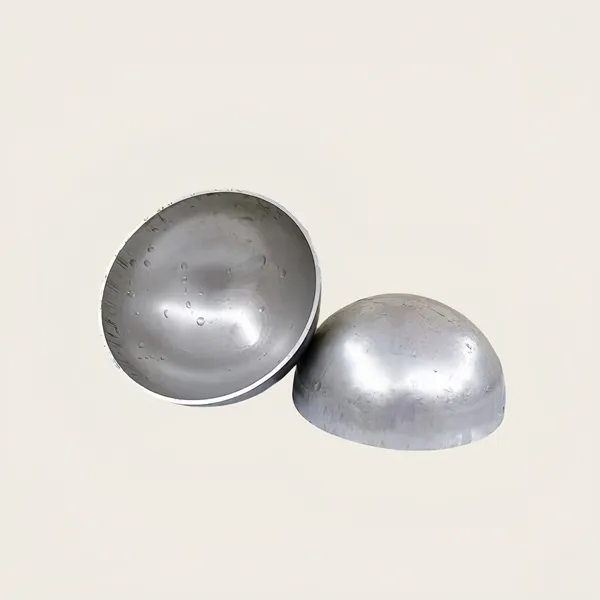
First off, let's talk about what domed tank ends are. Simply put, they're the rounded or curved parts that cap off the ends of a tank. These ends come in various shapes and sizes, but the most common ones are hemispherical, ellipsoidal, and torispherical. Each shape has its own unique pneumatic properties, which we'll explore in a bit.
Now, why are the pneumatic properties of domed tank ends so important? Well, when a tank is filled with a gas or a liquid under pressure, the tank ends have to withstand that pressure without failing. The pneumatic properties of the tank ends determine how well they can handle this pressure and ensure the safety and integrity of the entire tank system.
One of the key pneumatic properties of domed tank ends is their ability to distribute pressure evenly. When a tank is pressurized, the pressure acts on the inner surface of the tank ends. A well-designed domed tank end can distribute this pressure evenly across its surface, reducing the stress concentration at any one point. This is crucial because high stress concentrations can lead to cracks and failures in the tank ends, which can be extremely dangerous.
Hemispherical tank ends are known for their excellent pressure distribution capabilities. Their spherical shape allows the pressure to be evenly distributed over the entire surface of the end, making them ideal for high-pressure applications. For instance, in applications where the tank is used to store compressed gases like oxygen or nitrogen, hemispherical tank ends can provide a high level of safety and reliability. You can check out our Pressure Vessel Hemispherical Dished End for more details on this type of tank end.
Ellipsoidal tank ends also offer good pressure distribution. They have an elliptical shape, which is a bit flatter than a hemisphere. This shape allows for a more gradual transition from the cylindrical part of the tank to the end, reducing the stress concentration at the junction. Ellipsoidal tank ends are commonly used in medium-pressure applications, such as in the storage of water or other liquids.
Torispherical tank ends, on the other hand, have a more complex shape. They consist of a spherical section at the center and a toroidal (ring-shaped) section at the edge. This shape provides a good balance between pressure distribution and manufacturing cost. Torispherical tank ends are widely used in low to medium-pressure applications, such as in the food and beverage industry for storing liquids like milk or juice. You can find more information about Flanged and Dished Tank Heads, which are a type of torispherical tank end.
Another important pneumatic property of domed tank ends is their flexibility. When a tank is pressurized, the tank ends will deform slightly. A flexible tank end can accommodate this deformation without cracking or failing. This flexibility is especially important in applications where the tank is subjected to cyclic loading, such as in a reciprocating compressor.
The material used to make the domed tank ends also plays a significant role in their pneumatic properties. Common materials include carbon steel, stainless steel, and aluminum. Each material has its own set of mechanical properties, such as strength, ductility, and corrosion resistance, which can affect the tank end's ability to withstand pressure and deformation.
Carbon steel is a popular choice for domed tank ends because it is strong and relatively inexpensive. However, it is prone to corrosion, especially in environments where there is moisture or chemicals. Stainless steel, on the other hand, offers excellent corrosion resistance but is more expensive than carbon steel. Aluminum is lightweight and has good corrosion resistance, making it suitable for applications where weight is a concern, such as in aerospace or transportation.
In addition to pressure distribution and flexibility, the pneumatic properties of domed tank ends also include their resistance to buckling. Buckling occurs when the tank end collapses under pressure, usually due to a combination of high pressure and thin wall thickness. To prevent buckling, the tank ends need to have sufficient thickness and stiffness.
The design of the tank end, including its shape and dimensions, also affects its buckling resistance. For example, a hemispherical tank end with a thicker wall and a larger radius of curvature will generally have better buckling resistance than a torispherical tank end with a thinner wall and a smaller radius of curvature.

Now, let's talk about how we, as a domed tank end supplier, ensure that our products have the best possible pneumatic properties. We start by using high-quality materials and state-of-the-art manufacturing processes. Our engineers use advanced computer-aided design (CAD) and finite element analysis (FEA) software to optimize the design of the tank ends for maximum pressure distribution, flexibility, and buckling resistance.
We also conduct rigorous quality control tests on all our tank ends to ensure that they meet or exceed industry standards. These tests include non-destructive testing methods, such as ultrasonic testing and radiographic testing, to detect any internal defects or flaws in the tank ends.
If you're in the market for domed tank ends, whether it's for a new project or a replacement, we'd love to hear from you. Our team of experts can help you choose the right type of tank end based on your specific application requirements, including the pressure, temperature, and material compatibility. We can also provide you with detailed technical specifications and pricing information.
So, if you're interested in learning more about our Ms Dish End or any of our other domed tank end products, don't hesitate to reach out. We're here to help you find the best solution for your tanking needs.
In conclusion, the pneumatic properties of domed tank ends are crucial for the safe and efficient operation of tank systems. By understanding these properties and choosing the right type of tank end for your application, you can ensure the long-term reliability and performance of your tanks. Whether you need a high-pressure hemispherical tank end or a medium-pressure ellipsoidal tank end, we've got you covered.
References
- ASME Boiler and Pressure Vessel Code
- API Standards for Pressure Vessels
- Material Science and Engineering textbooks