

Hey there! As a supplier of domed tank ends, I've been getting a lot of questions lately about the difference between domed tank ends and flat tank ends. So, I thought I'd take a few minutes to break it down for you.
Let's start with flat tank ends. These are, well, flat. They're pretty straightforward and have been around for ages. Flat tank ends are easy to manufacture, which often makes them a cost - effective option. If you're on a tight budget, flat tank ends might seem like the obvious choice. They can be cut from a flat sheet of metal, and the welding process to attach them to the tank body is relatively simple.
However, flat tank ends do have their limitations. When it comes to pressure resistance, they're not the best. Since they're flat, they don't distribute pressure evenly across the surface. This means that under high - pressure conditions, the flat end can buckle or deform. Imagine a soda can with a flat top instead of a curved one. If you try to pressurize it, the flat top would likely bulge or burst much more easily than the curved top of a regular soda can. So, for applications where the tank will be holding liquids or gases under high pressure, flat tank ends may not be the most reliable option.
Now, let's talk about domed tank ends. I'm a big fan of these, of course, since I'm in the business of supplying them. Domed tank ends are curved, and this curvature gives them some significant advantages over flat tank ends.
One of the main benefits of domed tank ends is their superior pressure resistance. The curved shape distributes pressure evenly across the surface, which means they can handle much higher pressures without deforming. In high - pressure applications like in chemical processing plants, oil and gas storage, or even in some types of water treatment facilities, domed tank ends are the go - to choice. They're like the superheroes of tank ends, able to withstand the forces that would easily defeat their flat counterparts.
Another advantage of domed tank ends is their structural integrity. The curvature provides additional strength, which can make the entire tank more durable. This is especially important in industries where the tanks are subject to rough handling, vibrations, or other external forces. For example, in transportation applications, where tanks are moved around on trucks or ships, domed tank ends can better withstand the jolts and bumps along the way.
In terms of aesthetics, domed tank ends also have a more modern and sleek look compared to flat tank ends. They can give a tank a more professional and high - tech appearance, which might be important in some settings, like in a public water storage facility where the tank is visible.
But, like everything, domed tank ends aren't without their drawbacks. They are more complex to manufacture than flat tank ends. The process of forming the curve requires specialized equipment and skilled labor. This can make them more expensive upfront. However, when you consider the long - term benefits in terms of pressure resistance and durability, the extra cost can often be worth it.
Now, let's look at some specific types of domed tank ends. There are different shapes and designs available, each with its own unique properties. For instance, hemispherical domed tank ends are a popular choice. They offer the maximum pressure resistance because they have a perfect spherical shape. You can check out more about Steel Dish Heads and Ms Dish End on these links. These types of domed tank ends are often used in high - pressure vessels where safety and reliability are of the utmost importance.
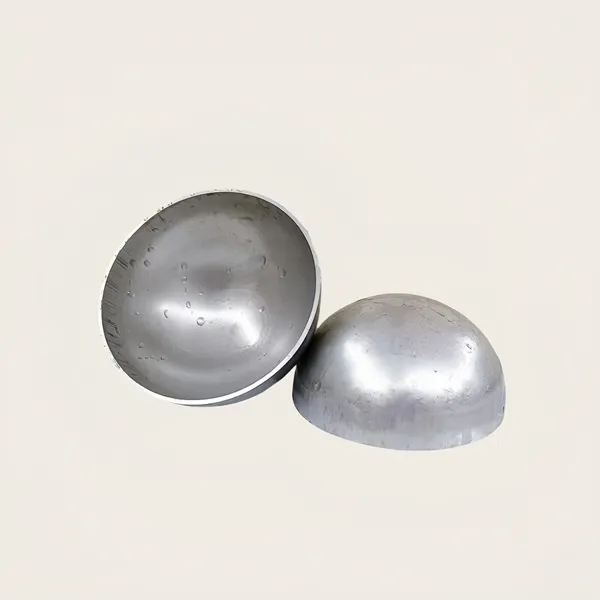

Another type is the torispherical domed tank end. It has a more rounded shape with a knuckle at the base. This design is a bit more forgiving in terms of manufacturing and can still provide good pressure resistance. Torispherical domed tank ends are commonly used in a variety of industrial applications, from food and beverage storage to pharmaceutical manufacturing.
If you're in the market for pressure vessels, you might be interested in Pressure Vessel Hemispherical Dished End. These are specifically designed to meet the strict requirements of pressure vessel applications, ensuring that your tank can safely hold pressurized substances.
So, how do you decide which type of tank end is right for your project? Well, it all comes down to your specific needs. If you're working on a low - pressure application with a limited budget, flat tank ends might be a good option. But if you need high - pressure resistance, durability, and a tank that can stand up to tough conditions, domed tank ends are the way to go.
As a supplier of domed tank ends, I've seen firsthand the difference that the right tank end can make. I've worked with customers in various industries, from small - scale local businesses to large multinational corporations. And in each case, we've been able to find the perfect domed tank end solution to meet their specific requirements.
If you're considering purchasing tank ends for your project, I'd love to have a chat with you. Whether you're still in the planning stages or you're ready to place an order, I can provide you with all the information you need to make an informed decision. I can answer your questions, give you a quote, and help you choose the right type of domed tank end for your application.
Don't hesitate to reach out if you have any questions or if you're interested in discussing your project further. I'm here to help you get the best tank ends for your needs.
References
- "Pressure Vessel Design Handbook" by Dennis R. Moss
- "Tank Engineering and Construction" by various industry experts